
I have always been less interested in history as something that is concluded than in history as something that is lived. What fascinates me is not how events are explained decades later, but how they are experienced from within—by ordinary people trying to make sense of a world that no longer behaves as expected.
Across cultures and eras, periods of great upheaval are often accompanied by shifts in consciousness. Sometimes these are remembered as myth, sometimes as catastrophe, sometimes as progress. The names change, but the pattern is familiar: a dominant worldview reaches its limits, contradictions accumulate, and eventually a rupture occurs. What follows is rarely graceful. There is regression, fear, polarization, and confusion. And then—slowly—something new begins to form.
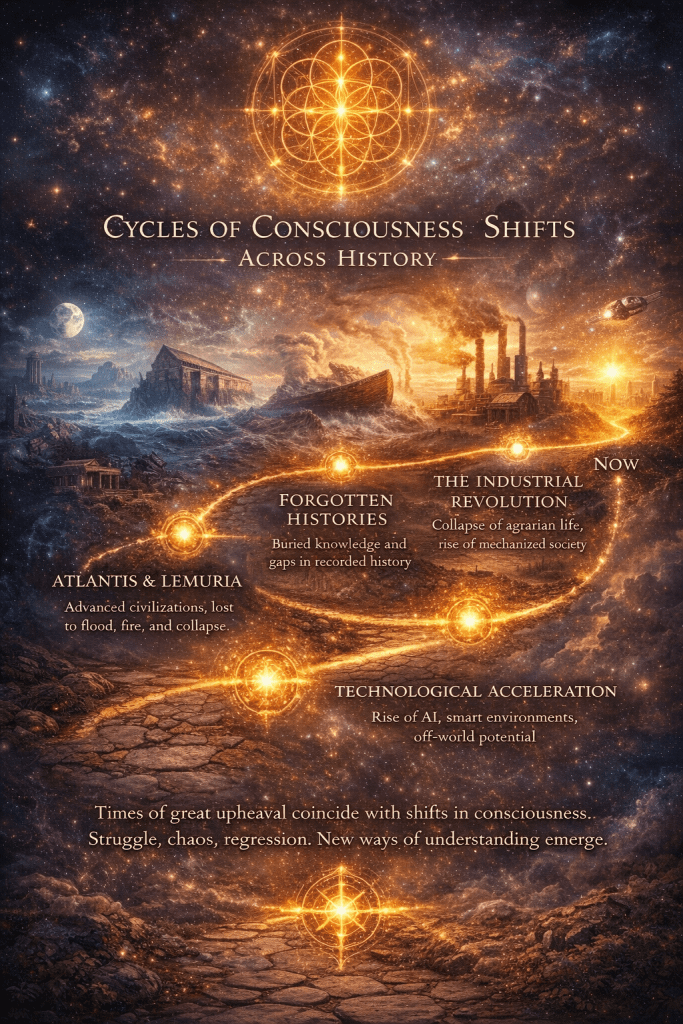
We see this pattern echoed in ancient stories of lost civilizations such as Atlantis or Lemuria, in flood narratives like Noah’s Ark, and in the many cultural myths that speak of worlds ending and beginning again. Whether interpreted literally or symbolically, these stories appear wherever humanity has endured profound disruption. They preserve memory of a passage: one consciousness dying so another might be born.
History offers more grounded examples as well. The Industrial Revolution permanently altered how humans understood labor, time, value, and progress. Entire ways of life disappeared within a generation. What was gained came with great cost, and the social consequences are still unfolding centuries later. Yet few would deny that a fundamental shift in human consciousness occurred during that period.
There are also moments in history where continuity itself feels broken—periods of rapid rebuilding, buried knowledge, or compressed narratives that leave behind questions rather than clarity. Whether these gaps are explained through ordinary historical processes, loss of records, or something more complex, they share a common feature: a break in how the world understands itself.
Discernment is the art of seeing how things belong together.
This way of seeing—placing events within their broader historical and psychological context—has shaped how I understand my own life. I have always experienced history not as something distant, but as something recognizable while it is unfolding. Being born in 1961, on the edge of Washington, D.C., during the years often idealized as Camelot, placed me at a cultural fault line. The assassination that followed marked more than the loss of a president; it marked the collapse of a shared narrative. What came after was an era of increasing institutional power, secrecy, and disillusionment—experienced differently by each generation, but felt nonetheless.
Fast forward to the present, and it is difficult to ignore that we are again living through a threshold moment.
What once belonged to speculative fiction or fringe conversation is now part of everyday life. Artificial intelligence, smart environments responding to voice and intent, satellite-based internet, off-world missions, rapid medical innovation—these are no longer abstractions. They are lived realities. Alongside them, we see intensified social fragmentation: those who embrace the changes, those who resist them entirely, and those who feel unmoored by the speed and scale of it all.
Artificial intelligence, in particular, marks a quiet but profound shift. For the first time, large numbers of people are no longer solely dependent on a single human authority to interpret legal, medical, historical, sociological, or even spiritual information for them. This does not remove bias or replace discernment—it demands more of it. It returns responsibility to the individual to sit with information, cross-reference, reflect, and decide.

Knowledge once mediated is now encountered directly.
As with every major transition, this redistribution of agency produces tension. Authority is questioned. Trust is renegotiated. Old structures strain under new conditions. History suggests that such moments are neither purely destructive nor purely redemptive. They are formative.
I am not interested in declaring what this moment is in absolute terms, nor in convincing anyone how they should interpret it. I am interested in recognizing its shape. Humanity stands at a junction where technology no longer merely extends our reach, but challenges our understanding of knowledge, power, and responsibility itself.
History does not ask us to solve these moments. It asks us to live coherently within them.
If there is a lesson carried forward from past consciousness shifts, it is this: the tools change, the stories change, but the work remains the same. To see clearly without becoming consumed by fear or certainty. To resist both blind faith and reflexive rejection. To develop discernment equal to the complexity of the age.
I do not claim to know how this chapter resolves. I only recognize the terrain—and understand why, for some of us, this moment feels strangely familiar.

Every age builds outward. The task is to tend the inner ground.
Discover more from Child of Hamelin
Subscribe to get the latest posts sent to your email.
 Child of Hamelin