We are living in a strange kind of fog. Not the gentle kind that rolls in from the sea, but a dense emotional mist made of headlines, breaking news alerts, viral outrage, and the constant sense that something urgent is always happening somewhere else. Every day seems to bring another shock — a political upheaval, a violent act, a technological breakthrough, a new fear to process — and yet, beneath all of this noise, a quieter transformation is unfolding. While our attention is pulled from one dramatic event to the next, an invisible architecture of sensors, networks, and artificial intelligence is steadily weaving itself into the fabric of everyday life. Most of us can feel that something profound is changing, even if we cannot yet clearly see what it is.
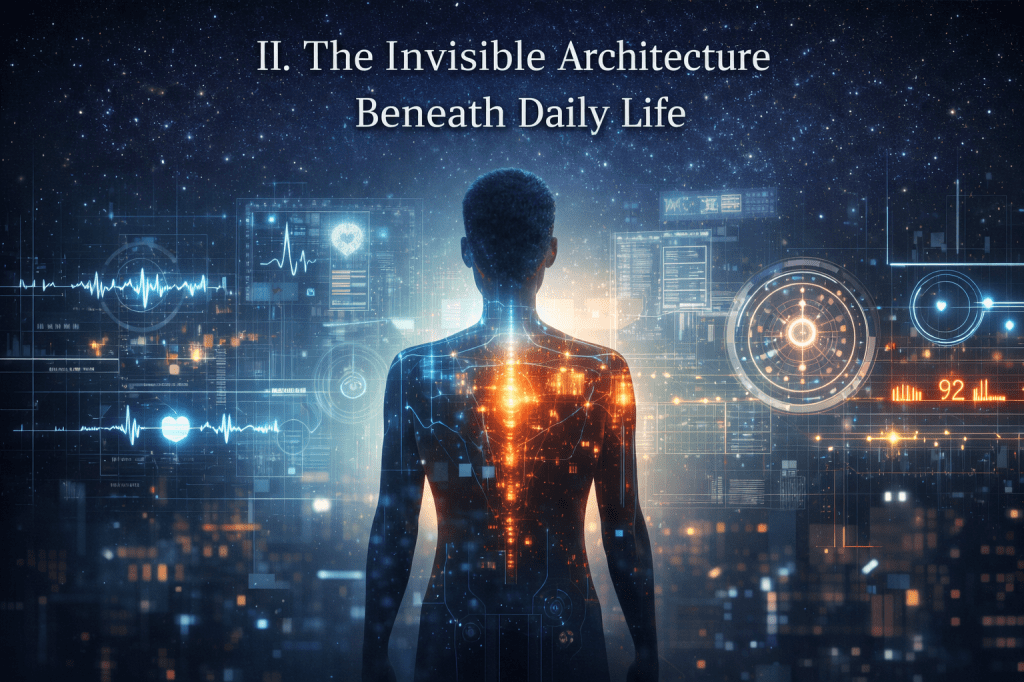
When people talk about “advanced technology,” they often imagine robots, glowing screens, or some distant future that has not quite arrived yet. In reality, the most consequential technologies of our time are not loud or theatrical. They are small, quiet, and everywhere. They sit on our wrists, in our pockets, in hospital rooms, at airport gates, in bank systems, and increasingly in the air and the space around us. They collect signals from our bodies and our environment, transmit them across wireless networks, and feed them into artificial intelligence systems designed to recognize patterns faster than any human mind ever could.
Over the past two decades, an entire class of technology has emerged that focuses not on what we do, but on how our bodies behave. This includes wearable devices that track heart rate, movement, sleep cycles, and oxygen levels; medical telemetry systems that transmit vital signs in real time; and biometric identification tools that recognize faces, voices, fingerprints, and even the subtle rhythms of a person’s heartbeat. Together, these form what engineers call Wireless Body Area Networks — networks of sensors placed on, in, or around the human body that continuously collect and transmit physiological data.
At the same time, artificial intelligence systems have become remarkably good at interpreting these streams of data. Modern AI does not need a single fingerprint or password to identify someone. It can recognize a person by the way they walk, the cadence of their voice, the pattern of their breathing, the temperature of their skin, or the tiny variations in their heart rhythm. This kind of multimodal biometric recognition is already used in everything from smartphone security to airport screening to financial fraud detection.
Even more quietly, researchers and defense agencies have been developing networks of microscopic sensors known as microelectromechanical systems, or MEMS — sometimes referred to as “smart dust.” These are tiny devices, small enough to be suspended in the air or carried on clothing, that can sense light, sound, motion, temperature, electromagnetic fields, and even biological signals. A recent U.S. patent describes systems in which these devices are activated by a nearby base station, dynamically selected based on environmental conditions, and used to authenticate a person by comparing the data they collect to a stored biometric profile.
None of this is science fiction. These technologies are already part of modern medicine, banking, defense, and consumer electronics. They are being built not as a single monolithic surveillance system, but as layers of infrastructure — standards, protocols, sensors, and algorithms — designed to make the physical world legible to machines. The result is a reality in which human bodies are increasingly readable, measurable, and identifiable in ways that would have been unimaginable just a generation ago.
When people speak about “frequency,” “vibration,” or “resonance,” they are often pointing toward something they feel but cannot easily name — the sense that the body is more than flesh and bone, that it is an energetic system in constant motion. What is striking about our present moment is that modern technology has begun to describe this same reality in a very different language. Engineers and scientists do not speak of aura or spirit, but they do speak of signals, waveforms, patterns, and noise. And in practical terms, that is exactly what much of the human body produces.
The heart, for example, is not only a pump. It is an electrical oscillator, sending rhythmic signals through the nervous system and into the surrounding electromagnetic field. The brain produces waves that shift with attention, emotion, and sleep. The voice carries subtle harmonic signatures unique to each individual. Even the way a person walks or breathes forms a recognizable pattern over time. When sensors measure these things and AI systems analyze them, what they are really doing is reading the living signal of a human being.
This is why modern biometric systems no longer rely on a single data point. They combine many signals at once: facial structure, voice tone, pulse, motion, temperature, and more. Artificial intelligence then compares these data streams against known patterns, determining whether the person in front of the system matches the profile it expects. In this sense, the machine is not “seeing” a person — it is recognizing a complex, evolving signature.
It is easy, in this environment, for people to slip into mystical language about technology reading their “energy” or “frequency.” In a way, they are not entirely wrong. But what the technology is actually reading are the measurable expressions of life itself: electrical rhythms, acoustic vibrations, thermal fluctuations, and physical movement. These are not metaphors. They are the raw materials of both biology and signal processing.
What matters, however, is not just that these signals can be measured. It is that they can be correlated, stored, and compared across time. A human might recognize a loved one by the sound of their voice or the way they move. A machine can do the same thing, but at scale, with thousands of variables, across millions of people, and without ever getting tired. That is the quiet power of this new technological layer — not that it replaces human perception, but that it multiplies it in ways we are only beginning to grasp.
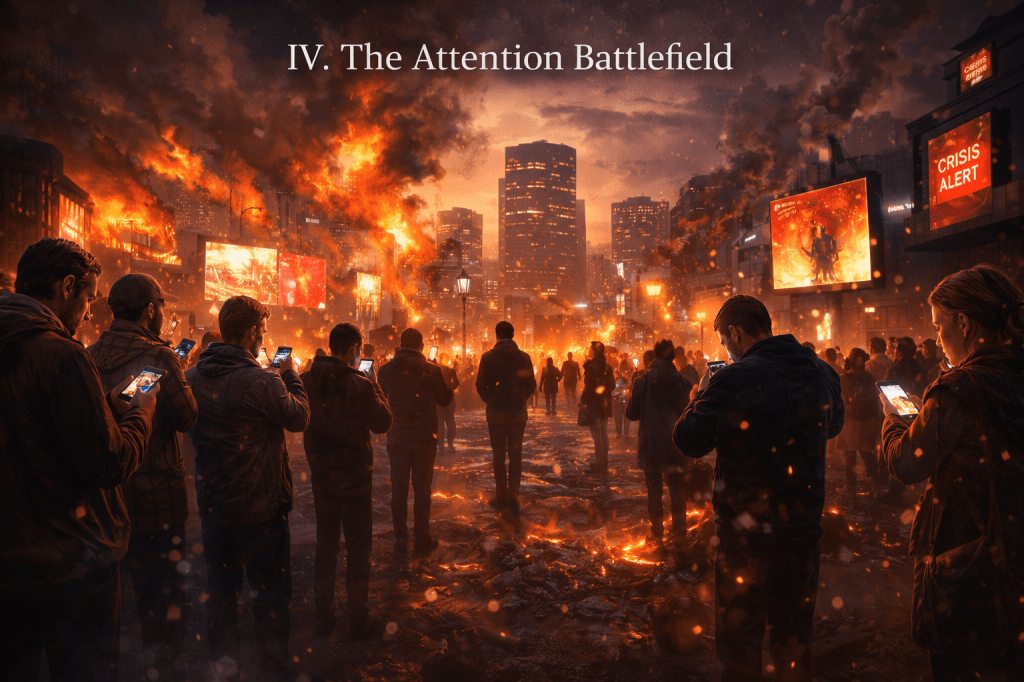
If the most powerful technologies of our time are quiet and infrastructural, then the loudest forces in our culture are emotional. Every day, we are pulled into waves of outrage, fear, tribal loyalty, and moral panic. News alerts flash across our screens. Social media feeds erupt over the latest scandal, tragedy, or political crisis. Each event demands an immediate reaction, as though the fate of the world hinges on our ability to be angry, frightened, or certain right now.
This is not an accident. In an economy built on attention, emotion is the most valuable currency. Platforms are designed to amplify whatever keeps people scrolling, sharing, and reacting, and nothing does that more reliably than fear and outrage. Researchers have shown that emotionally charged content spreads faster and farther than calm, nuanced information. Political strategists and military analysts alike have begun to describe this environment as a form of cognitive or information warfare — a battlefield where perception itself becomes the target.
In this environment, dramatic events are not just news; they are attention sinks. A violent incident, a geopolitical shock, or a viral controversy can consume millions of hours of collective focus. Meanwhile, slower and more technical changes — new surveillance standards, new biometric systems, new data-sharing agreements, new AI deployments — move forward with little public scrutiny. By the time most people notice them, they are already part of everyday life.
This does not mean that the tragedies and conflicts we see are unreal or unimportant. It means that they are embedded in a media ecosystem that thrives on emotional saturation. When people are constantly reacting, they have little space left for deep observation. When fear and outrage dominate, subtle structural shifts pass unnoticed. The result is a population that feels overwhelmed by events, yet strangely disconnected from the deeper forces shaping their future.
This is the heart of emotional steering: not telling people what to think, but keeping them too emotionally occupied to notice what is quietly being built around them.
When people sense that powerful technologies are being deployed quietly, while their lives are shaped by forces they cannot see, a psychological gap opens. Into that gap rush stories, rumors, leaked videos, anonymous accounts, and dramatic testimonies. Some of these may be partially true. Many are distorted. Others are pure invention. But all of them share a common origin: the human need to make sense of a world that doesn’t feel transparent.
In a high-tech, high-secrecy environment, uncertainty is unavoidable. Military systems, intelligence tools, and corporate data platforms are not designed to be publicly legible. They operate behind legal, technical, and proprietary walls. Meanwhile, ordinary people experience the effects — sudden geopolitical shifts, algorithmic decisions, economic disruptions, and unfamiliar forms of surveillance — without being given a clear explanation of how those outcomes were produced. It is in this space that extreme narratives flourish.
When someone encounters a story about a small, technologically superior force overwhelming a much larger one, or about mysterious weapons that incapacitate people without visible wounds, what they are really responding to is not just the content of the story, but the feeling behind it: that modern power has become asymmetric, opaque, and deeply unbalanced. Even when such accounts cannot be verified, they resonate because they reflect a genuine intuition — that the tools now available to states and corporations far exceed what most citizens understand or control.
This is why it is so important to hold a disciplined form of curiosity. To dismiss every extraordinary claim as nonsense is to ignore the very real technological gulf that now exists. But to accept every dramatic account as literal truth is to surrender discernment. The wiser stance is to recognize these stories as signals — not necessarily of what has happened, but of how disoriented and powerless many people feel inside an increasingly automated world.
In other words, the narratives we see spreading online tell us less about secret weapons and more about a collective psyche trying to orient itself in a landscape where technology has outrun everyday human understanding.
For all its power, technology has one profound limitation: it can only measure what can be turned into data. Sensors can record electrical signals, chemical levels, motion, sound, and light. Artificial intelligence can detect patterns within those measurements. But there is an entire dimension of human life that does not appear in any dataset — the interior world of meaning, memory, conscience, and choice.
A machine may recognize a face, but it does not know what it feels like to see someone you love. It may detect a change in heart rate, but it does not know what it means to grieve, to forgive, or to pray. It may classify a voice by its tone and cadence, but it does not understand the intention behind the words. These things belong to what might be called the inner witness — the lived experience of being a conscious human being inside a body.
This is what spiritual traditions across time have pointed to when they speak of the soul, the spirit, or the sacred. It is not an object that can be scanned, nor a frequency that can be captured. It is the place from which we choose, love, repent, create, and awaken. No amount of biometric data can tell a system what a moment of awe feels like, or why a quiet prayer can steady a frightened heart.
In a world where bodies are increasingly legible to machines, this interior dimension becomes more precious, not less. The more external systems can see, track, and predict, the more vital it is that human beings remain rooted in what only they can inhabit: their inner life. This is not an escape from reality. It is the deepest form of presence within it.
Technology may learn to read the signals of the body, but it cannot enter the sanctuary of the soul.
In an age of accelerating technology and constant emotional stimulation, the most radical act may be the simplest: to slow down, to observe, and to tend one’s own inner world. When attention is pulled in a thousand directions, discernment becomes a form of sovereignty. When narratives compete for our outrage, stillness becomes a kind of shield.
This does not mean turning away from the world. It means engaging it without surrendering our nervous system, our conscience, or our sense of self to forces we do not fully understand. The more data-driven and automated our surroundings become, the more important it is to remain anchored in what is not automated: reflection, empathy, intuition, and moral choice.
We may not yet know the full extent of the technologies now shaping our lives. We may never see the entire architecture behind the screens. But we do not need complete technical mastery to preserve something far more essential. We need the courage to remain inwardly awake — to question, to feel, to pray, to listen, and to notice when our emotions are being steered rather than honored.
The future will be built by machines and networks. But the meaning of that future — and the spirit that animates it — will still be decided by human beings. Technology does not carry intention; people do. And while we may be surrounded by systems we did not choose, we are never trapped inside purposes we do not claim.
If the tools we are creating are powerful, then the hearts that guide them must be wiser still. The highest work of our time is not to outrun technology, but to meet it with consciousness, compassion, and a commitment to the good of all.
That work begins, as it always has, in the quiet places within us.
Discover more from Child of Hamelin
Subscribe to get the latest posts sent to your email.
 Child of Hamelin