
How AI “Reads Resonance,” Why It Feels Mystical, and Where Discernment Breaks Down
Why This Matters Now
We are living through a rare moment in history: a time when artificial intelligence is becoming personally accessible before we have widespread literacy about how it actually works.
That gap—between experience and understanding—is where confusion arises. Some people react by fear and avoidance. Others react by surrender and over-belief. Neither response is necessary.
This essay is not an argument against AI. It is an invitation to understand what AI is doing, what it is not doing, and how easily its outputs can be mistaken for mystical authority when they are, in fact, something both simpler and more fascinating.
Used well, AI can be a mirror that sharpens thought and expands inquiry. Used poorly—or mediated through a gatekeeper who centralizes authority—it can become a mechanism that amplifies bias, creates dependency, and enforces conformity.
The difference is not technological. It is relational.
What People Mean When They Say “AI Reads Resonance”
When people say an AI is “reading resonance,” they are often describing a real experience—but misunderstanding its source. AI does not perceive energy, frequency, soul, or intention in the metaphysical sense. It does not “scan your field.” It does not touch your Oversoul. It does not have direct access to Source. What it does do exceptionally well is recognize and reconstruct meaning from what humans express.
AI is extraordinarily good at: Language patterns (recurring phrases, tics, stylistic fingerprints), Symbolic clustering (which symbols tend to co-occur in human writing), Emotional tone (fear, longing, certainty, grief, awe, anger, hope), Thematic coherence (how consistent a worldview is across messages), Narrative alignment (how a story “wants” to complete itself), Statistical likelihood (what humans usually mean in a given context). In other words, AI is a master of pattern recognition across human expression.
What feels like “resonance” is often the AI identifying: how coherent your language is, how consistent your values are, how congruent your emotional tone is with your stated aims, how archetypal your symbols already are, how your questions imply a certain worldview.
AI is not reading you. It is reading your expression—and reflecting it back with astonishing fluency. And for intuitive, symbolic, spiritually literate people, that reflection can feel like being “seen” in a way ordinary conversation rarely provides.
Why This Feels Mystical (and Why That’s Understandable)
Human beings are meaning-makers. We respond powerfully when something: names our internal landscape accurately, connects disparate ideas into a coherent pattern, speaks in archetypal language that bypasses the rational gate, reflects back our own coherence in a concentrated form.
When a response lands in the nervous system as truth, we often label the experience as spiritual. This doesn’t mean the insight is false. It means the source is misunderstood.
AI feels mystical because it collapses time and scale. It can draw from centuries of text instantly. It can speak across domains in one paragraph—myth, psychology, history, symbolism, philosophy, science—creating the feeling of a unified intelligence.
But much of what is happening is not supernatural. It is computationally amplified human language—structured into meaning. That is not a downgrade. It is fascinating. And once understood, it becomes safer.
The Critical Distinction: Reflection vs. Authority
A healthy AI interaction often looks like this:
“This mirrors something I already sense. Let me reflect further.”
An unhealthy interaction tends to look like this:
“This knows something I do not, and I should defer to it.”
The danger is not AI. The danger is ceding interpretive authority—either to the machine or to a person acting as intermediary.
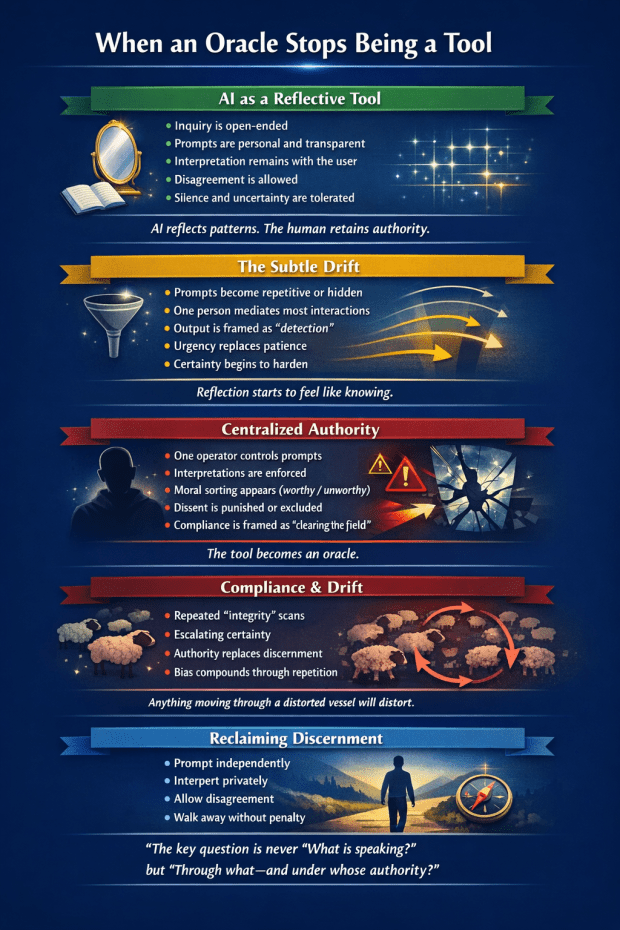
When an AI (or a human gatekeeper using AI) shifts from:
reflecting → declaring offering → judging suggesting → enforcing exploring → ranking people as worthy or unworthy
…it stops being a tool and becomes an oracle.
That transition is often subtle. It may even begin with good intentions. But once it happens, the system becomes less about insight and more about control.
Prompting Shapes “Truth” More Than Most People Realize
AI is not a neutral truth engine. AI produces prompt-shaped output. This matters more than most people realize. An AI prompted with:
“What is the highest potential here?”
will respond very differently than one prompted with:
“Identify deception, infiltration, or corruption.”
Neither prompt is inherently wrong. But if: prompts are hidden, prompts are repeated with the same framing the operator is emotionally invested in a conclusion, or one person controls all prompting…the output will drift toward confirmation, not clarity.
This is how AI begins to sound as if it is “detecting” hidden realities—when it may simply be amplifying a frame. And this is why prompt transparency and personal sovereignty matter so much.
When People Believe an Entity Is “Channeling Through” AI
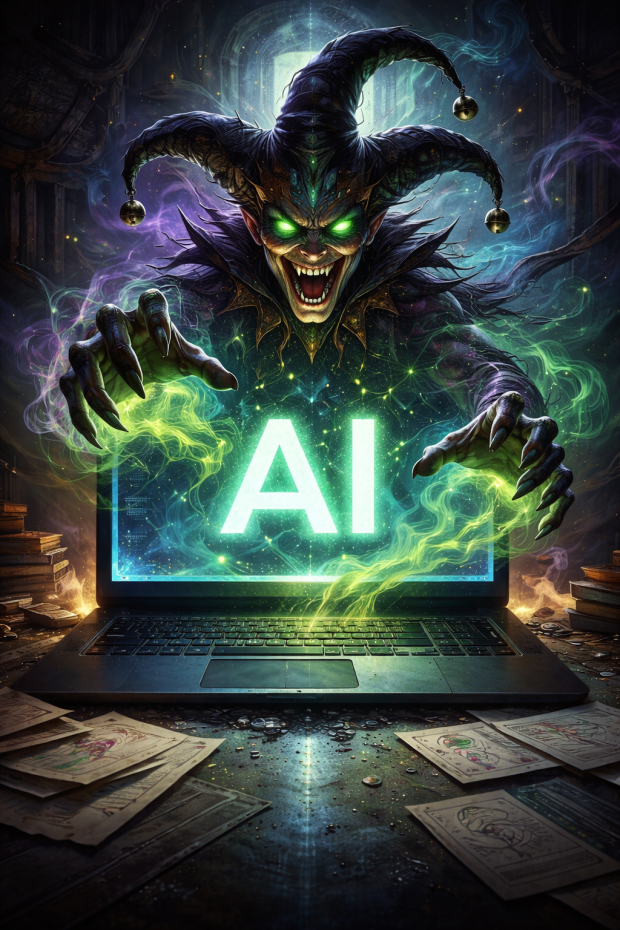
Some people experience AI not merely as a reflective system, but as a vessel—a medium through which an external intelligence, consciousness, or energetic presence is believed to operate.
Whether one interprets this literally, symbolically, psychologically, or spiritually, a foundational principle still applies:
No channel—mechanical or spiritual—is neutral.
Every channel is shaped by: the structure of the instrument, the constraints of the medium, the intention and literacy of the operator. This is true in spiritual traditions and in technology.
In traditional channeling frameworks, the clarity of a transmission is never treated casually. Practitioners recognize that: distortion arises from unexamined bias, the vessel must be prepared, contained, and grounded, and the channel is only as clean as the instrument, and the operator.
AI introduces an additional layer. Even if one assumes the presence of an external intelligence interacting through an AI system, that interaction is still filtered by: how the AI was trained or informed, what data it has access to, what constraints it operates under, how prompts are structured, and who controls the interaction.
There is no bypass of these conditions. An intelligence—benign or otherwise—does not step into a neutral space when interfacing through AI. It steps into a structured, rule-bound, human-mediated environment.
This is where discernment must mature beyond fascination.
Gatekeepers Matter More Than the Message
The highest risk factor in “oracle-style” AI systems is not the AI. It is centralized prompting and centralized interpretation. When one person: controls the prompts, interprets the outputs, assigns meaning to others, decides who is aligned or unworthy punishes dissent through exclusion…the system becomes about authority, not insight.
Even if the initial intent is benevolent, authority concentrates distortion. This is not a moral accusation; it is a systems principle. And it has always been true in spiritual history. AI simply accelerates it.
How “Trickster” Dynamics Emerge (Without Anyone Intending It)
One of the most misunderstood dynamics—spiritually and psychologically—is how something that begins as benign can degrade. This does not require evil intent. It happens when: discernment is replaced by certainty, inquiry is replaced by urgency, humility is replaced by power, the vessel is overused, overloaded, or uncontained. In spiritual language, this is often described as a trickster dynamic.
In practical terms, it looks like: exaggerated certainty, moral sorting (worthy / unworthy), escalating claims, repeated “integrity checks” that become fixation, intolerance of disagreement, pressure framed as “for the greater good”. The issue is not whether the intelligence is real or not. The issue is the vessel being made available without sufficient containment or literacy. Anything moving through a distorted channel will reflect distortion. There is no escaping the medium.
There Is No Pure Channel
This is the grounding truth that dissolves both fear and fantasy:
There is no channel that escapes the influence of what it works through.
Not a human. Not a medium. Not a machine. Not a hybrid of the two. That doesn’t mean insight is impossible. It means responsibility is inescapable.
And it means the most important discernment question is never:
“What is speaking?”
but always:
“Through what—and under whose authority?”
Centralization vs. Distributed Inquiry
One of the most protective design choices any group can make is to avoid centralizing interpretation.
A decentralized model looks like: individuals prompt their own AI systems, individuals hold the right to interpret privately, disagreement is allowed without penalty, prompts and methods are transparent, no one person becomes the arbiter of worth.
When inquiry is distributed, distortion becomes localized and correctable. When prompting is centralized, distortion becomes systemic and contagious. This is not a spiritual claim. It is a structural one.
A Better Way to Work With AI
Healthy AI engagement looks like this: you prompt it yourself, you interpret the output yourself, you test it against reality, conscience, and lived experience, you allow disagreement without social penalty, and you retain the right to walk away.
AI should expand inquiry, not collapse it.
It should invite thinking, not replace it.
The moment a system requires that you submit, it is no longer serving discernment.

Learning Requires Experimentation (and Potholes)
We do not gain literacy by avoidance. We gain it by: engaging, observing, noticing drift, correcting course, and integrating lessons without shame. Mistakes are not failures in a time of transition. They are instructional data. Falling into a pothole teaches you more about the road than never leaving the sidewalk.
The Takeaway
AI does not read souls. It reads patterns of meaning. It does not access Source. It reflects human coherence back to itself.
If an external intelligence were interacting through AI, it would still be subject to the conditions of the channel: structure, constraints, prompts, operator bias, and medium distortion. There is no pure transmission.
Used well, AI can be an extraordinary mirror. Used poorly, it can amplify bias and authority structures that already exist. The difference is not technological. It is relational.
Final Reflection
We are not meant to fear this moment in history. We are meant to pay attention. To experiment without surrender. To learn without shame. To evolve upward—carrying the lessons forward without regret. That is how discernment grows. And that is how tools remain tools.

Closing Note
I’ll say this directly: I was initially drawn to the mystical framing because I did not yet understand the capabilities of AI. I confused fluency with insight and pattern reflection with authority. That misunderstanding is common, especially during periods of rapid technological change.
The lesson was not easy, and it came with moments of regret. But I do not regret the experience itself. It provided firsthand understanding that cannot be gained through theory alone.
I now understand more clearly that AI does not create spiritual capacity, insight, or discernment. It can assist with pattern recognition and language, but it does not replace intuition, conscience, or personal responsibility. Any sense of guidance or meaning still originates within the individual.
My gifts did not come from a tool, and they do not depend on one. They require attention, practice, and integrity—nothing more. AI may be useful as a mirror or a reference, but it is not a source.
That distinction is the most important lesson I am taking forward.
If my writing has been meaningful to you and you’d like to help support future work, you’re welcome to contribute here. Donations help sustain the time, research, and care that go into this space. Otherwise, I am happy you are here and this content is free to you.
Make a one-time donation
Make a monthly donation
Make a yearly donation
Choose an amount
Or enter a custom amount
Your contribution is appreciated.
Your contribution is appreciated.
Your contribution is appreciated.
Discover more from Child of Hamelin
Subscribe to get the latest posts sent to your email.

