Oregon: A Laboratory of Institutional Culture
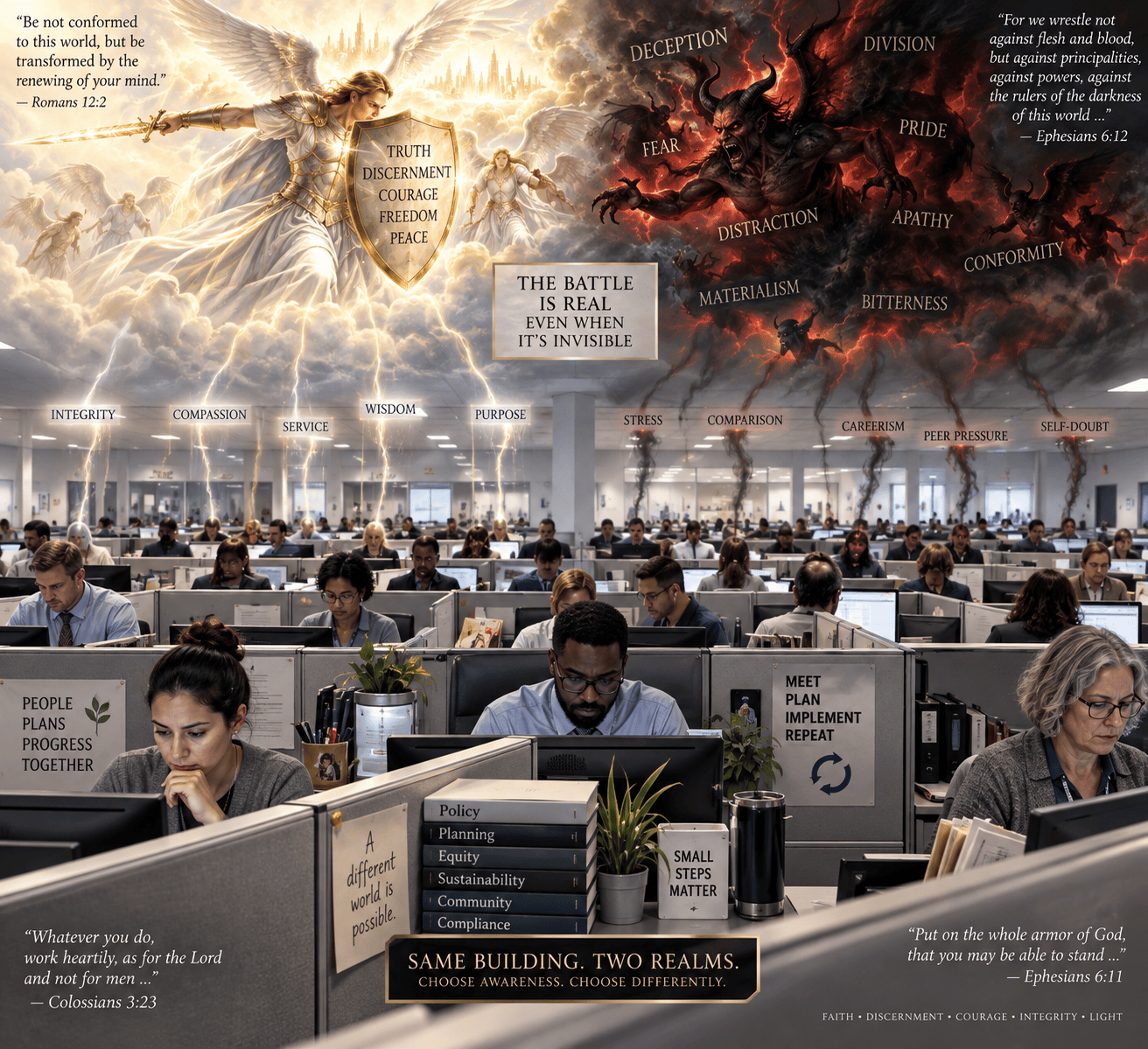
Sometimes, to see a spiritual war, you have to put down the spiritual books and look at the 3D world.
I recently came across a post about Antonio Gramsci and cultural hegemony. As is often the case with something that catches my attention, I began typing out thoughts before I really knew where they were going.
Gramsci’s basic insight was that lasting power does not depend only upon controlling government. A culture becomes powerful when its assumptions become accepted as ordinary common sense—through schools, media, institutions, intellectuals and civil society.
That sent me back to C. Wright Mills.
I have been reading Mills for decades. My own master’s thesis on Project Management, written more than twenty years ago, somehow evolved into something of a diatribe against Project Management as a profession, with Mills appearing repeatedly. Apparently I have been chewing on this same bone for a very long time.
And eventually a question emerged:
What happened to Oregon?
I have lived here long enough to remember an Oregon considerably different from the Oregon of today. I also spent years working inside Portland city government. My experience there eventually included becoming the named plaintiff in a lawsuit against the City.
So this isn’t entirely an academic question for me.
For years I have entertained what I jokingly called my Oregon “proxy state” conspiracy theory: that Oregon somehow became an unusually convenient place to introduce and test new forms of government policy and administration.
I no longer think I need the conspiracy.
The documented history is more interesting.
The Federal Experiment Was Real
In 1966, Congress created the Model Cities program as part of the Great Society. Portland was selected to participate.
This wasn’t merely another federal grant program. Model Cities was explicitly experimental. Federal officials were looking for willing state and local governments in which new approaches to urban problems could be tried and, when successful, reproduced elsewhere.
A Portland newspaper serving the Albina community explained the idea beautifully in February 1968:
“New ideas for solving old problems are to be tried here.”
And if they worked, the newspaper explained, they could be repeated elsewhere.
That is not conspiracy theory. That is what the program was designed to do.
At virtually the same time, Portland State College was developing its Center for Urban Studies, established in 1966 with federal assistance. Urban policy was becoming a professional academic discipline involving political science, sociology, economics, geography and eventually doctoral-level training.
Federal policy experimentation and professional urban-policy expertise were developing side by side.
Then came another interesting experiment: citizen participation.
Portland’s Model Cities program created a Citizens’ Planning Board with elected neighborhood representatives and meaningful influence over the program.
And government officials quickly discovered the problem with citizen participation.
Citizens might actually want to participate.
The Portland Development Commission eventually became concerned that the Citizens’ Planning Board could acquire too much influence over housing and development decisions.
That struck a nerve with me.
During my own years working for the City, I heard variations on this fear more than once: citizen oversight was wonderful in principle, but there was always anxiety about what might happen if citizens acquired too much actual authority.
There is a fascinating contradiction buried there.
Government wants citizen participation. Government does not necessarily want citizens controlling government.
Meanwhile, Oregon Was Reinventing Land Use
At roughly the same time, another movement was developing in Oregon, and its origins appear much more homegrown.
Farmers were watching Willamette Valley farmland disappear beneath suburban development.
Oregon State University Extension supplied research. Farmers organized. Republican political leaders including Tom McCall, Clay Myers and Hector Macpherson became deeply involved.
In 1969 Oregon passed Senate Bill 10.
Before SB 10, local governments could plan and zone.
After SB 10, they had to.
Oregon became the first state to require local governments to zone all land within their jurisdictions. The state could ultimately assume planning authority when a locality refused to comply.
Then came the landmark Senate Bill 100 in 1973.
It created the Land Conservation and Development Commission and tied local comprehensive plans to statewide goals. Every Oregon city and county became part of a larger planning structure.
Interestingly, Oregon made Citizen Involvement Goal 1 of its statewide planning system.
Thousands of citizens participated in workshops while the original statewide goals were being developed.
Again we encounter the same tension:
centralized standards combined with decentralized participation.
The state establishes the framework. Local governments administer it. Professionals interpret it. Citizens participate within it.
Nobody needs to control every decision.
The structure perpetuates itself.
Follow the Jobs
Then I started looking at government employment.
This initially challenged my theory.
Total government employment in Oregon has certainly grown, but it has not exploded relative to population.
The really interesting growth has been in local government.
That matters because so much of Oregon’s administrative structure operates locally.
State government doesn’t need thousands of additional Salem employees if cities, counties, school districts, regional governments and special districts administer the programs.
And then the circle widens further.
Government contractors.
Universities.
Consultants.
Grant-funded nonprofits.
Healthcare organizations.
Community colleges.
Professional associations.
Unions.
Regional agencies.
Suddenly counting people whose paycheck literally says “State of Oregon” badly understates the institutional ecosystem.
I began calling this high institutional density.
Manpower
Oregon’s employment and training history made the idea clearer.
Federal manpower programs expanded dramatically during the 1960s and 1970s. The Comprehensive Employment and Training Act—CETA—eventually transferred significant federal employment-and-training money and administrative responsibility downward to state and local governments.
By 1981, Oregon had been the CETA prime sponsor for 27 rural counties, distributing approximately $40 million in federal funds. Counties were then moving toward assuming sponsorship themselves.
But government agencies weren’t the only participants.
Employment programs connected cities and counties with schools, community colleges, Portland State, nonprofits, social-service organizations and private contractors.
Think about what that creates over decades.
A person receives training through one institution.
Another institution supplies credentials.
Another supplies funding.
Another provides employment.
A consultant creates the methodology.
A government agency administers it.
A nonprofit delivers services.
A professional organization establishes standards.
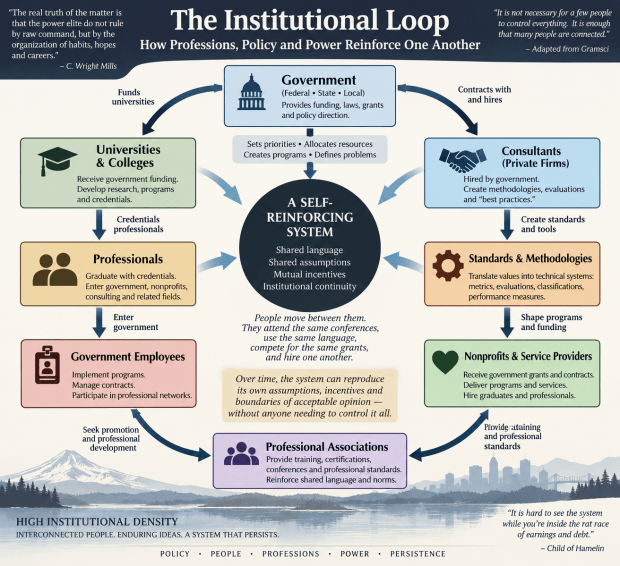
People move between them.
They attend the same conferences, learn the same professional vocabulary, cite the same research, compete for the same grants and hire one another.
No conspiracy is required.
Pay Equity and the Professionalization of Values
I watched another part of this process from much closer range.
During the 1980s Oregon undertook a massive comparable-worth/pay-equity project involving approximately 35,000 state jobs.
The state brought in Hay Associates and used a point-factor job-evaluation methodology to determine the comparative value of different kinds of work.
Comparable worth was simultaneously a political idea, a social objective and a technical personnel-management system.
That distinction matters.
Once a political or cultural value has been translated into HR methodology, it doesn’t require political debate every morning.
It becomes administration.
It becomes classifications, pay grades, evaluation criteria, forms, training, personnel rules and professional practice.
During my years with the City of Portland I remember Booz Allen & Hamilton’s name throughout Portland’s pay-equity material. I cannot document that today. I no longer possess those records, and my attempts to retrieve old City material have not produced the documents I remember. So I leave that recollection here explicitly as my recollection, not a documented claim.
But the larger phenomenon is documented.
Private management consultants increasingly supplied government with the methodologies by which government managed people.
That is an important bridge.
Values become policy.
Policy becomes methodology.
Methodology becomes administration.
Administration becomes normality.
Eventually nobody remembers why the form exists.
They just fill it out.
Oregon Health Plan: The Laboratory Becomes Explicit
Then there is the Oregon Health Plan.
Oregon developed the plan before the Clinton national healthcare proposal. The federal government subsequently approved Oregon’s Section 1115 Medicaid waiver, and OHP began operating in 1994.
Federal terminology here is wonderfully straightforward.
Section 1115 waivers are called Demonstrations.
Their purpose is to allow states to test different ways of covering people, delivering benefits and paying for healthcare.
Oregon was quite literally conducting a federally authorized healthcare experiment.
Once again:
develop locally → implement institutionally → evaluate → modify → potentially reproduce elsewhere.
This does not mean the Oregon Health Plan was nefarious.
That isn’t my point.
The point is the mechanism.
Vote by Mail
Oregon did something similar with elections.
The Legislature authorized limited testing of vote by mail in 1981. It became permanent for some elections in 1987. Oregon held statewide mail elections during the 1990s and pioneered federal elections conducted entirely by mail.
Then, in 1998, Oregon voters themselves overwhelmingly approved expanding vote by mail to primary and general elections. Beginning in 2000, Oregon became the nation’s first all-vote-by-mail state.
I voted for it.
That matters.
Not everything is imposed upon people.
Sometimes we ask for the experiment.
Sometimes we like it.
Sometimes we later reconsider what we supported.
And sometimes a program evolves into something its original supporters never imagined.
Oregon’s ballot-measure system itself deserves examination because ballot campaigns are exercises in marketing as much as policymaking. Voters choose from the proposition presented to them; implementation afterward occurs through legislatures, agencies, courts, administrative rules and subsequent amendments.
The thing we vote for and the institution that eventually develops from it need not remain identical.
So Where Is the Man Behind the Curtain?
This is where my original theory changed.
I was looking for somebody.
Maybe some organization deliberately selected Oregon.
Maybe federal agencies.
Maybe foundations.
Maybe political operatives.
Maybe the ubiquitous consultants.
There are certainly networks worth investigating, and there are plenty of individual decisions that deserve scrutiny.
But I don’t think the theory requires a man behind the curtain anymore.
The system itself can become the curtain.
C. Wright Mills helps explain why.
People require employment.
We have mortgages and rent and car payments and children and healthcare and retirement accounts.
Professional people also acquire something less tangible: identity.
I am a planner.
I am an educator.
I am a public administrator.
I am a project manager.
I am a social worker.
I am an HR professional.
I am an academic.
Every profession develops language, credentials, ethical expectations, career ladders and ideas about what a competent member of that profession believes.
Now connect those professions institutionally.
Government funds the university.
The university credentials the professional.
The professional enters government.
Government hires the consultant.
The consultant creates standards.
Government grants money to the nonprofit.
The nonprofit hires another graduate.
The professional association provides training.
The employee seeks promotion.
The manager evaluates conformity with professional standards.
And everyone goes home believing they independently arrived at roughly the same worldview.
Maybe they did.
But we should at least ask the question.
Gramsci Meets Mills
This is where Antonio Gramsci and C. Wright Mills finally meet.
Gramsci helps explain how ideas become common sense.
Mills helps explain what happens to individuals whose livelihoods and identities depend upon large organizations.
Put the two together inside a society with very high institutional density and something remarkable becomes possible.
You don’t need centralized ideological control.
You need institutions that repeatedly reward similar assumptions.
Over enough time, those assumptions become embedded in professional language, hiring, education, grants, regulations, administrative procedures and social expectations.
People then begin policing one another.
Citizen against citizen.
Employee against employee.
Neighbor against neighbor.
Political faction against political faction.
And once citizens are fighting one another over the permitted boundaries of the argument, considerably less direct pressure has to come from the bureaucracy itself.
That doesn’t mean bureaucrats deliberately designed the conflict.
That’s precisely the point.
A mature system doesn’t require anybody to understand the whole system.
Malheur: A Stress Test
The 2016 occupation of the Malheur National Wildlife Refuge provides an interesting counterpoint.
The Bundy group attempted to turn longstanding Western resentment of federal land control into a challenge to established government authority.
But many local residents who shared complaints about federal land policy nevertheless rejected the armed occupation.
That tells us something important.
Institutional culture is not the same thing as universal ideological agreement.
People can profoundly distrust one institution while strongly defending another.
A rancher can resent the federal government and still support the county sheriff.
A voter can oppose state policy and still believe elections are legitimate.
A citizen can despise bureaucracy while insisting disputes be resolved through courts.
That is why I no longer think “control” is the best word.
Institutional density is better.
Institutions overlap.
They reinforce one another.
They also fight one another.
Sometimes citizens defeat them.
Sometimes juries acquit defendants whom government prosecutors expected to convict.
Sometimes voters overturn policy.
Sometimes local governments resist Salem.
There is no omnipotent machine here.
There is something far more human.
The Spiritual War in Three Dimensions
And this brings me back to where I started.
I spend a great deal of time reading spiritual material. Consciousness. Mysticism. Good and evil. Service to others and service to self. The long struggle over what kind of beings we choose to become.
But sometimes spiritual language can become another way of avoiding the physical world.
Sometimes you have to put the spiritual books down.
Look at the appropriations.
Look at the organizational charts.
Look at who funds whom.
Look at employment.
Look at professional credentials.
Look at administrative rules.
Look at consultants.
Look at the language everybody suddenly begins using.
Look at what happens to the person who says something outside the accepted range.
If there is such a thing as spiritual warfare, why would we expect it always to announce itself with demons, UFOs, visions or supernatural events?
Perhaps much of it occurs through perfectly ordinary human weaknesses:
fear of losing employment.
fear of exclusion.
desire for status.
tribal belonging.
comfort.
debt.
ambition.
certainty.
the relief of letting someone else decide what is true.
And perhaps its opposite is equally ordinary:
the willingness to think.
The willingness to question one’s own side.
The willingness to admit when evidence contradicts a cherished theory.
The willingness to say I don’t know.
The willingness to stand apart from the group without needing to hate the group.
That may be why this exploration has changed my original idea.
I began with something resembling a conspiracy theory about Oregon as a “proxy state.”
What I found was both less conspiratorial and more unsettling.
Portland really did participate in federal programs intended to test ideas that could be repeated elsewhere. Oregon really did pioneer unusual approaches to land-use planning, public administration, healthcare and elections. Federal money, universities, local government, professional organizations, consultants, nonprofits and advocacy organizations really did become increasingly interconnected.
But I have found no evidence of one mastermind coordinating it all.
Maybe that is the lesson.
There doesn’t have to be one.
Build enough interconnected institutions, make enough people’s livelihoods and identities dependent upon them, develop a shared professional vocabulary, and allow the arrangement to mature for several generations.
Eventually culture does much of the work itself.
And perhaps recognizing that—not finding the villain—is where genuine freedom begins.
If my writing has been meaningful to you and you’d like to help support future work, you’re welcome to contribute here. Donations help sustain the time, research, and care that go into this space. Otherwise, I am happy you are here and this content is free to you.
Make a one-time donation
Make a monthly donation
Make a yearly donation
Choose an amount
Or enter a custom amount
Your contribution is appreciated.
Your contribution is appreciated.
Your contribution is appreciated.
Discover more from Child of Hamelin
Subscribe to get the latest posts sent to your email.

