
When service becomes attachment, perhaps the soul is asking for something different.
I went for a walk today.
Nothing particularly remarkable about that, except that I had been feeling rather lost lately.
I walked along the sidewalk, carrying the familiar noise of responsibilities and unresolved conflicts in my head.
It wasn’t until I turned around to head home that I noticed something lying on the sidewalk.
A single, two-sided page from an old religious publication.
I picked it up.
The first word that caught my attention was a name.
Elijah.
My immediate thought was the mystic.
I had gone outside hoping to find a little peace. And on the journey home, I found a reminder of something I feared I had lost.
For months, I had become increasingly absorbed in the affairs of a community organization where I volunteer. There were records to reconstruct, bylaws to interpret, procedures to correct, elections approaching, and personalities to navigate.
Oh, the personalities.
Anyone who has served in a volunteer organization knows that sometimes the greatest challenge isn’t accomplishing the work. It’s surviving the committee meetings.
Somewhere along the way, I had allowed this little corner of the material world to take up residence in my head. Rent-free, of course.
And the rent was getting expensive.
Not in dollars, but in something considerably more valuable: my peace.
The Mystic Goes Missing
For years, my spiritual life has been centered on contemplation, meditation, intuitive knowing, synchronicities, and communion with what I call Source—the One Infinite Creator.
I believe consciousness is fundamental to existence, that we participate in Creation, and that the divine is not separate from us but present throughout all things.
My spiritual exploration has drawn me through the Bible, the mystical traditions, the teachings of Edgar Cayce, the Law of One, and other sacred and esoteric writings.
One of my practices is bibliomancy: approaching a text with a question or intention, allowing a passage to present itself, and contemplating its meaning.
But I hadn’t practiced in weeks.
My meditations had fallen away. My quiet time had disappeared. My attention had become occupied with grievances, responsibilities, and the seemingly endless business of managing the world of form.
I had become entangled.
And what troubled me most was the fear that perhaps I wouldn’t find my way back.
What if the mystic had gone missing for good?

A Message on the Path
During my walk, I came across two pages from an old religious publication.
They were pages 107 and 108 of the April 2020 General Conference of the Church of Jesus Christ of Latter-day Saints.
I picked them up.
The first thing that caught my attention was a name.
Elijah.
Immediately, I thought: The mystic.
Only afterward did I notice another word.
FamilySearch.
Now that was interesting.
Years earlier, after moving to this Oregon town, a cousin had introduced me to FamilySearch, the genealogical research platform. Through it, I discovered that my family was distantly related to some of the pioneer families who settled this area.
And here I was, years later, volunteering in a historic agricultural and community organization, helping preserve records and maintain traditions stretching back through generations.
Ancestry. Community. History. Service.
All connected by two discarded pages.
Some might call it coincidence.
I call such moments synchronicity. Within my understanding of the divine, nothing exists outside Source, although that doesn’t mean I can claim certainty about the precise meaning of every encounter.
The question isn’t necessarily whether God arranged for those pages to appear.
The question is what I might learn from finding them.
Elijah in the Wilderness
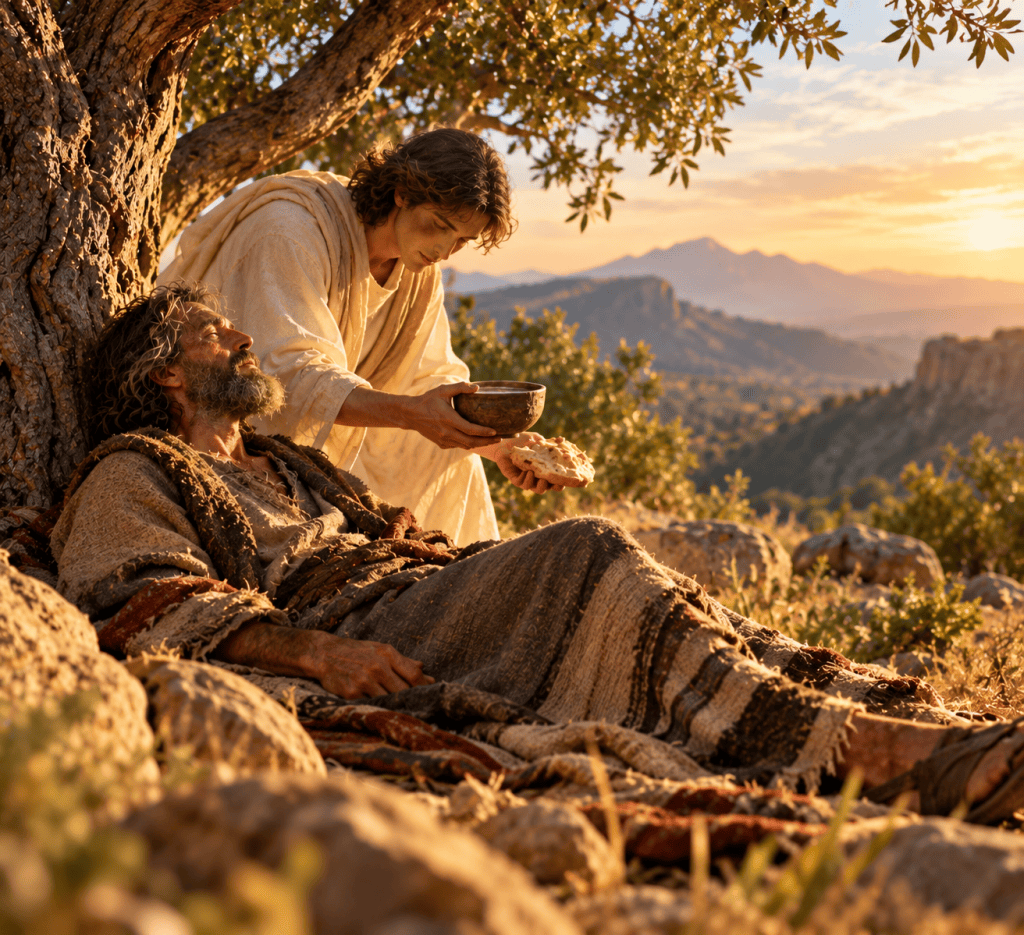
Elijah is one of the great prophetic mystics of the Hebrew Bible.
His story in 1 Kings 19 has always intrigued me, but this time I noticed something particularly relevant.
Elijah had become exhausted.
He had confronted powerful opposition, endured tremendous conflict, and reached a point where he could bear no more.
He withdrew into the wilderness.
And what happened next?
He was not immediately handed another assignment.
He was given food.
He was allowed to sleep.
He was nourished again.
Only later did he journey to Horeb, the mountain of God, where he encountered the wind, the earthquake, and the fire.
But the divine presence was revealed to him in the still small voice.
How easily we overlook the sequence.
Before the revelation came restoration.
I had been so busy trying to keep everything running properly that I had neglected the quiet necessary for my own spiritual nourishment.
I was attempting to serve others while allowing my inner life to become depleted.
And perhaps, like Elijah, I needed a little time in the wilderness.
Not to abandon the world.
But to remember who I was within it.
When Stewardship Becomes Ownership
There was another uncomfortable realization waiting for me.

As part of my volunteer responsibilities, I had spent countless hours organizing and reconstructing records.
I had become fiercely protective of them.
I even caught myself referring to them as my files.
My files?
They weren’t mine.
They belonged to the organization.
I was their custodian.
Somewhere between responsibility and devotion, stewardship had quietly become attachment.
And attachment, as so many spiritual traditions teach, is a remarkably effective way to manufacture suffering.
The Bhagavad Gita teaches the importance of acting without attachment to the fruits of our actions.
The Law of One describes the circumstances of ordinary life as catalysts through which consciousness may evolve.
Christian teachings repeatedly return to surrender, humility, and trust.
Different traditions, different language, yet a recurring challenge:
Can we participate fully in life without allowing its outcomes to define our peace?
I had become invested not only in doing my work well, but in how others performed theirs.
When people failed to meet my expectations, I became frustrated.
When procedures were ignored, I became indignant.
When others entered the records I had worked so hard to organize, I felt territorial.
Some of my concerns were legitimate. Accountability matters. Proper procedures matter. Responsible stewardship matters.
But legitimate concerns do not automatically justify unlimited emotional investment.
There is a point at which caring becomes controlling.
And I had wandered uncomfortably close to it.
The Mantle of Elijah
The pages I found also spoke about the spirit of Elijah turning the hearts of children toward their fathers and fathers toward their children.
In Latter-day Saint theology, this is deeply connected to genealogy and sacred ordinances for ancestors.
For me, it carried another meaning.
I thought about the historical records I had been preserving, my own ancestral discoveries, and the generations of people who had built the community in which I now lived.
Then I remembered another part of Elijah’s story.
His mantle passed to Elisha.
The work continued, but it did not require Elijah to remain its perpetual caretaker.
There is a lesson in that image.
Perhaps one of the most difficult acts of service is knowing when to entrust something precious to another person.
Especially when we suspect they won’t do it quite the way we would.
Perhaps that is precisely where the lesson begins.
To serve without possessing.
To guide without controlling.
To build something worthwhile and then allow others to carry it forward.
This does not mean surrendering discernment or tolerating misconduct. Nor does it mean every responsibility should be abandoned at the first sign of difficulty.
It means recognizing that service and self-sacrifice are not always synonymous.
Sometimes service asks us to step forward.
Sometimes it asks us to step aside.
The Question of Balance
Later, I returned to my bibliomancy journal.
I wrote:
Query: What would be helpful for me to reflect upon today?
Intention — Balance: Where might I benefit from holding multiple possibilities rather than choosing a single conclusion?
The words came after the discovery, rather than before it.
Perhaps I had done my bibliomancy backward.
Or perhaps the encounter had already begun the inquiry.
I had been considering whether to seek a greater leadership position in the organization, remain in my present role, or find another way to serve.
Part of me wanted to help correct the dysfunction I perceived.
Another part wanted nothing more than to return to my writing, meditation, and spiritual exploration.
And beneath those competing desires was a troubling question:
If I stepped away from all this activity, would I still recognize myself?
Would my intuitive knowing return?
Would the synchronicities and the communion with Source become familiar again?
Or had I somehow lost that part of myself?
Then I considered the possibility that perhaps nothing had been lost at all.
Perhaps I had simply become too occupied to listen.

Line Upon Line
The pages I found emphasized that divine purposes unfold gradually, that worthwhile work is accomplished through the efforts of many, and that understanding comes step by step.
One phrase particularly stayed with me:
“Line upon line, precept upon precept, here a little and there a little.”
I had been looking for a decision.
Perhaps what I needed was perspective.
The world of form is not my enemy. It is where I live, where I encounter others, where I make choices, and where spiritual principles are tested.
But it is not the entirety of my existence.
I can serve my community without surrendering my interior life.
I can care about integrity without becoming consumed by other people’s shortcomings.
I can honor my ancestors without assuming responsibility for preserving every institution they might have known.
And I can acknowledge that sometimes the wisest action is not to do more.
It is to become still enough to discern what is actually mine to do.
Returning to the Mystic
I don’t yet know which position, if any, I will seek in the coming election.
For once, I am willing to leave the question open.
What I do know is that I need recovery time.
Time to meditate.
Time to write.
Time to walk without mentally rehearsing the next committee disagreement.
Time to sit quietly with Source without demanding a revelation, an answer, or even a particularly mystical experience.
I have spent much of my life learning that spiritual development is not a destination. It is an ongoing process of remembering, forgetting, and remembering again.
Perhaps this is another such moment.
I went for a walk feeling disconnected from the mystic within me.
I returned carrying two discarded pages that spoke of Elijah, ancestry, sacrifice, service, and divine timing.
I cannot tell you why those pages were there.
But I can tell you what they helped me recognize.
I had not necessarily lost my connection to Source.
I had allowed the noise of the world to become louder than my willingness to listen.
And perhaps the greatest lesson was not about which mantle I should take up next.
Perhaps it was about recognizing which one I was finally ready to lay down.
The still small voice does not need to compete with the noise.
I need only make room to hear it.

Discover more from Child of Hamelin
Subscribe to get the latest posts sent to your email.

